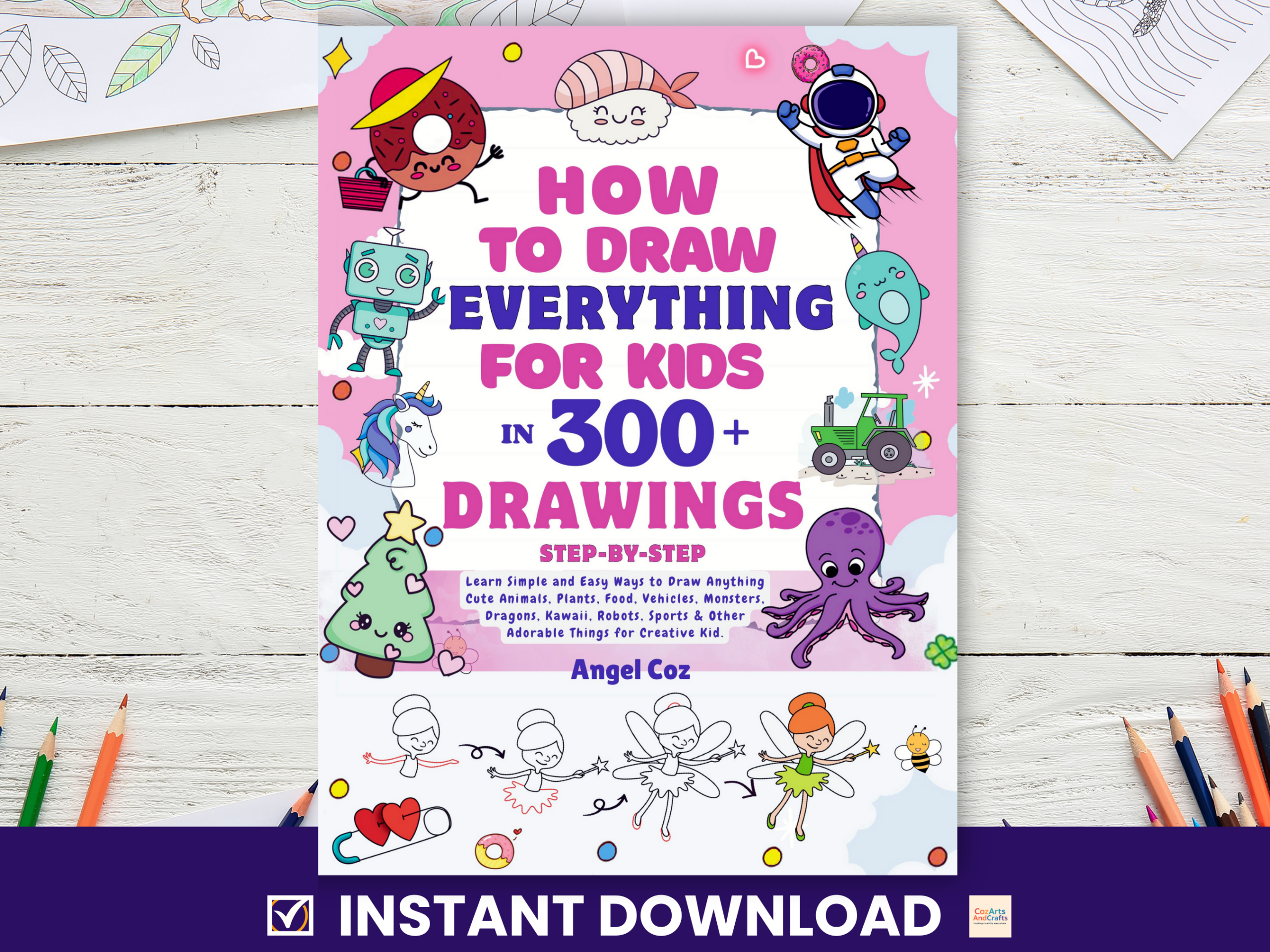
How to Draw Everything 300 Cute Stuff for Kids: The Only Step-by-Step Drawing Book That Actually Works
If you’ve ever searched “how to draw everything” or “how to draw everything book for kids,” chances are you were looking for something very specific: a drawing book that doesn’t confuse your child, doesn’t frustrate them halfway through, and doesn’t end up abandoned after a few pages.
Most parents don’t realize how common this problem is until they’ve bought two or three drawing books that promised fun—but delivered disappointment.
This guide exists to answer one question honestly:
What is the best “how to draw everything” book for kids—and why do most others fail?
Why Most “How to Draw Everything” Books for Kids Disappoint Parents
Let’s address the elephant in the room. Many negative reviews of kids’ drawing books repeat the same complaints:
- Parents say the steps are unclear.
- Kids say, “Mine doesn’t look like that.”
- Drawings jump too fast from simple to complex.
- Kids feel stuck, erase constantly, or quit.
The issue is not that children “can’t draw.”
The issue is that most books don’t actually teach drawing.
They show finished pictures and expect kids to reverse-engineer the process on their own.
For a child between ages 6 and 13, that’s overwhelming.
What Kids Actually Need to Learn How to Draw Everything
Children don’t need talent.
They don’t need tracing pages.
They don’t need artistic parents hovering nearby.
What they need is a visible process.
A true how to draw everything for kids book must do three things consistently:
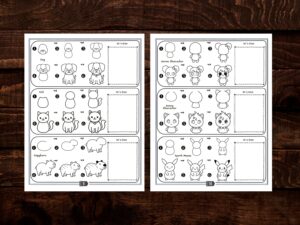
First, it must break drawings into small, visible steps.
Second, each step must clearly show what changed from the last one.
Third, the child must be able to finish the drawing successfully.
When these conditions are met, confidence grows naturally.
Why “300 Drawings” Matters More Than It Sounds
Many parents see the phrase “how to draw everything 300 drawings” and assume it’s just a number.
It’s not.
Volume matters because children learn through repetition and variety. When kids draw many different subjects—animals, food, vehicles, monsters, robots, dragons, kawaii characters—they begin to recognize patterns.
They stop memorizing pictures and start understanding how drawings are built.
In How to Draw Everything for Kids in 300 Drawings Step-by-Step, every drawing follows the same predictable structure, even though the subjects change dramatically.
That consistency is what allows kids to feel confident moving from one page to the next.
The Hidden Skill Most Drawing Books Never Teach: Spotting Differences
One of the most important skills children develop while drawing is the ability to spot the difference from one step to the next.
This book doesn’t just ask kids to draw—it quietly trains them to observe.
- Children compare Step 1 to Step 2.
- They notice what was added.
- Kids understand why the drawing changed.
This strengthens visual awareness, attention to detail, and concentration. It’s also why children using step-by-step systems tend to stay focused longer than with random art activities.
Fine Motor Skills Without Worksheets or Drills
Parents often search for creative ways to improve fine motor skills. What they don’t want are boring exercises that feel like homework.
Step-by-step drawing develops fine motor control naturally.
Children guide their hands carefully.
They repeat controlled movements.
They practice coordination without realizing it.
Because each drawing feels purposeful, kids stay engaged—and that’s when real learning happens.
Why Kids Finish This Book (When They Don’t Finish Others)
One of the biggest differences parents notice is completion.
Kids actually finish drawings in this book.
That’s because:
- The steps are small and achievable
- No erasing is required
- Progress always moves forward
- Success is built into the structure
Completion builds confidence. Confidence builds motivation. Motivation keeps kids drawing.
This is why many parents describe the experience as finally finding a drawing book that works.
What Makes This a True “How to Draw Everything” Book
Unlike many generic drawing books, this one lives up to the promise of its title.
Inside, children learn how to draw:
- Cute animals and pets
- Dinosaurs and dragons
- Food, snacks, and desserts
- Vehicles and machines
- Robots, monsters, and fantasy characters
- Everyday objects and patterns
All using the same simple step-by-step method, repeated across 300 drawings.
This repetition is intentional. It’s how children internalize the process and begin drawing independently.
Designed for Independent Use (But Great for Families Too)
One of the most common parent frustrations is needing to sit beside their child and explain every step.
This book removes that burden.
The visual instructions are clear enough for children to follow on their own. Parents can step back, observe progress, and enjoy the results.
It works equally well for:
- Home use
- Homeschooling
- Classroom quiet time
- Gifts and screen-free activities
- From “I Can’t Draw” to “Look What I Made”
The most powerful transformation parents notice isn’t artistic—it’s emotional.
Children who once avoided drawing begin opening the book on their own. They finish pages. They show their work. They ask to draw more.
That shift—from frustration to pride—is exactly what this book was designed to create.
Final Thought for Parents
If you’ve been disappointed by other how to draw everything for kids books, you’re not alone—and you’re not doing anything wrong.
The difference isn’t your child.
The difference is the method.
When drawing is taught step-by-step, with clarity and patience, kids don’t just learn how to draw everything—they learn to believe they can.
And that’s a skill that lasts far beyond the page.
Where to Get the Book
You can choose the format that fits your family best:
👉 Paperback on Amazon (great for gifts and hands-on use):
How to draw everything 300 cute stull Paperback book for kids is available on Amazon (Click here)
👉 Instant eBook on Etsy (perfect for immediate access or printing):
Meanwhile, the printable eBook is available in this Etsy Shop (Click here)